pathoffAll countries for move & retire

Move & retire

Mexico

The clearest published route to settlement here — attached to the lowest safety score.

4/4
ingredients confirmed
Every ingredient this page asks for has a figure and a source.
Living
~$2,250/mo
Couple, all in. Compared at country level, so capital cities and large metros run higher. The price level behind it prices the basket residents buy, and a foreign renter cannot reach the cheap end of local housing — poorer countries may still sit too low here.
Safety
Low
Near the bottom of the index, and the national figure hides enormous variation between states
ResidencyRecently changed
Means-tested, published, and it ends in permanence
Consulates moved to assessing solvency in UMA units in 2026, which changed the amounts, and individual consulates apply them differently. Treat any specific figure as consulate-specific.
Healthcare
Voluntary public cover, with holes in it
Out-of-pocket spending is 41.2% of current health expenditure here (World Bank, 2023, CC BY 4.0). Read it with care: the measure counts only what insured people pay — not premiums, and not the uninsured — which is why the United States comes out at 10.9%, ahead of most countries on this site.

More is being checked.

Where these figures came from

One row per ingredient. Open any of them for the source, how far we trust it, and when we last checked.

Living~$2,250/mo

Pathoff judgement directed by evidence, not computed from it: the country’s position comes from the World Bank household consumption price level for 2024 (0.590 of the United States, CC BY 4.0 — the ICP benchmark carried forward annually by the World Bank’s own method); the US reference budget is ours. See the Pathoff method, section 12.

Couple, all in. Compared at country level, so capital cities and large metros run higher. The price level behind it prices the basket residents buy, and a foreign renter cannot reach the cheap end of local housing — poorer countries may still sit too low here.

Confidence
made by us from the source
SafetyLow

Global Peace Index 2026: rank 139 of 163, score 2.65. Converted by the Pathoff GPI formula (GPI in lib/scoring.ts)

Near the bottom of the index, and the national figure hides enormous variation between states

Confidence
made by us from the source
ResidencyMeans-tested, published, and it ends in permanence

Pathoff outcome rubric (the Pathoff method, section 10-4), residency band "A route with conditions you can meet": Temporary residence on economic solvency is open to someone arriving with income or savings, the thresholds are published, and four years of it leads to permanent residence. High in the band. Short of the open band because the first card is issued for one year and renewal is at the immigration authority’s discretion.

Consulates moved to assessing solvency in UMA units in 2026, which changed the amounts, and individual consulates apply them differently. Treat any specific figure as consulate-specific.

Confidence
made by us from the source
Rule
Changed recently — older guidance elsewhere is out of date
Last checked
2026-09
HealthcareVoluntary public cover, with holes in it

Pathoff healthcare rubric (the Pathoff method, section 13-2), band "Covered, with a private top-up in practice": A resident without formal employment can enrol voluntarily in IMSS at an age-based published price, waits push most people to cheap private care alongside it, and serious treatment is done in the country. At the very foot of the band because the voluntary scheme excludes pre-existing conditions and applies waiting periods, which is a larger hole than a queue.

Out-of-pocket spending is 41.2% of current health expenditure here (World Bank, 2023, CC BY 4.0). Read it with care: the measure counts only what insured people pay — not premiums, and not the uninsured — which is why the United States comes out at 10.9%, ahead of most countries on this site.

Confidence
made by us from the source
Rule
No change known to us
Last checked
2026-09

What it is like here

Mexico publishes what it wants: an income or savings threshold, a temporary residence card, and permanent residence after four years. Costs are around half the US level, IMSS can be joined voluntarily, and private care is cheap and quick. The trade-off is blunt and it is the safety line — 139th of 163 — and the fact that the financial thresholds moved in 2026 when consulates changed the unit they are calculated in.

How the process works

1

Apply at a consulate abroad, not in Mexico

Residence on economic solvency is granted by a consulate; you cannot switch from a tourist entry.

1–3 months
2

Exchange for a residence card within 30 days

Missing the window means starting again from outside the country.

2–6 weeks
3

Four years, then permanent residence

Renewals run one, then up to three years, and the fourth year opens permanent status.

4 years

Where people settle

Mérida / Yucatán
The safest corner of the country and a large foreign-resident community
Lake Chapala / Ajijic
The oldest established retiree colony in Latin America
Querétaro / San Miguel de Allende
Temperate, central, and well above the national safety average

Open any ingredient above to see where its figure came from, how far we trust it and when we last checked. Nothing here is a substitute for the official source. Last reviewed 2026-09-04.

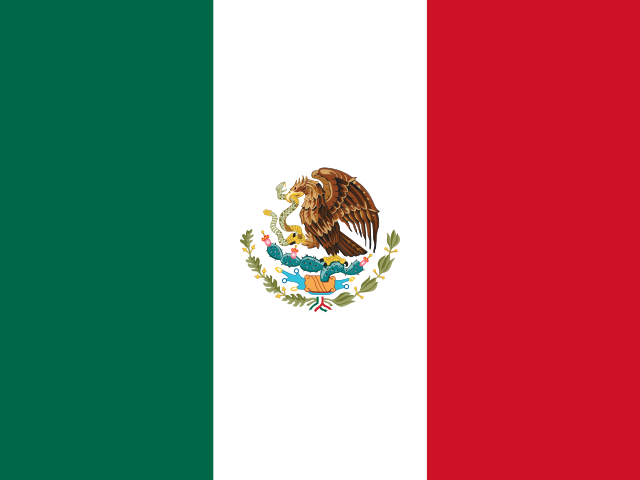
Photograph of Mexico by Gobierno CDMX, licensed CC0, via Wikimedia Commons.