pathoffAll countries for move & retire

Move & retire

Japan

Among the best healthcare anywhere, behind a ten-year wait and no door for savings.

4/4
ingredients confirmed
Every ingredient this page asks for has a figure and a source.
Living
~$2,500/mo
Couple, all in. Compared at country level, so capital cities and large metros run higher. The price level behind it prices the basket residents buy, and a foreign renter cannot reach the cheap end of local housing — poorer countries may still sit too low here.
Safety
Very high
Tenth globally, and the highest-ranked country outside Europe on the index
ResidencyRecently changed
Work, business or family, then ten years
The Highly Skilled Professional points system shortens the wait to three years at 70 points and one year at 80, which is among the fastest anywhere — but it is gated on points and a minimum income, so it is not a route most arrivals can plan on. The Business Manager capital requirement rose from ¥5m to ¥30m on 16 October 2025, with language, experience and staffing conditions added.
Healthcare
Universal, capped, and no referral needed
Out-of-pocket spending is 12.2% of current health expenditure here (World Bank, 2023, CC BY 4.0). Read it with care: the measure counts only what insured people pay — not premiums, and not the uninsured — which is why the United States comes out at 10.9%, ahead of most countries on this site.

Where these figures came from

One row per ingredient. Open any of them for the source, how far we trust it, and when we last checked.

Living~$2,500/mo

Pathoff judgement directed by evidence, not computed from it: the country’s position comes from the World Bank household consumption price level for 2024 (0.657 of the United States, CC BY 4.0 — the ICP benchmark carried forward annually by the World Bank’s own method); the US reference budget is ours. See the Pathoff method, section 12.

Couple, all in. Compared at country level, so capital cities and large metros run higher. The price level behind it prices the basket residents buy, and a foreign renter cannot reach the cheap end of local housing — poorer countries may still sit too low here.

Confidence
made by us from the source
SafetyVery high

Global Peace Index 2026: rank 10 of 163, score 1.489. Converted by the Pathoff GPI formula (GPI in lib/scoring.ts)

Tenth globally, and the highest-ranked country outside Europe on the index

Confidence
made by us from the source
ResidencyWork, business or family, then ten years

Pathoff outcome rubric (the Pathoff method, section 10-4), residency band "Work, family or business only": No retirement or passive-income status exists. Employment, business or family, then permanent residence after ten years of continuous residence. Mid-band: the routes work and lead somewhere, but the qualifying period is twice most of Europe’s and the business route was materially narrowed in 2025.

The Highly Skilled Professional points system shortens the wait to three years at 70 points and one year at 80, which is among the fastest anywhere — but it is gated on points and a minimum income, so it is not a route most arrivals can plan on. The Business Manager capital requirement rose from ¥5m to ¥30m on 16 October 2025, with language, experience and staffing conditions added.

Confidence
made by us from the source
Rule
Changed recently — older guidance elsewhere is out of date
Last checked
2026-09
HealthcareUniversal, capped, and no referral needed

Pathoff healthcare rubric (the Pathoff method, section 13-2), band "Covered, and it covers everything": Every resident staying over three months must enrol, premiums are income-linked, and the high-cost medical expense benefit caps monthly out-of-pocket payments, so the worst case is knowable in advance. Patients can go straight to a specialist. Level with Germany: faster access, against a 30% co-payment Germany does not charge.

Out-of-pocket spending is 12.2% of current health expenditure here (World Bank, 2023, CC BY 4.0). Read it with care: the measure counts only what insured people pay — not premiums, and not the uninsured — which is why the United States comes out at 10.9%, ahead of most countries on this site.

Confidence
made by us from the source
Rule
No change known to us
Last checked
2026-09

What it is like here

Everyone resident joins the national health insurance, the monthly out-of-pocket cost is capped by law, and specialists can be seen without a referral — this is close to the best combination on the site. Against that: no retirement or passive-income status exists, permanent residence normally takes ten years, and the business route was tightened sharply in October 2025 when the capital requirement went from ¥5m to ¥30m.

How the process works

1

Find a status you actually qualify for

There is no self-sufficiency route; the application has to name work, business or family.

Timing not confirmed
2

Register the address and join health insurance

Within 14 days of receiving the residence card, at the ward office.

1 day
3

Ten years, or points

Permanent residence normally needs ten years; the points system can cut it to three or one.

1–10 years

Where people settle

Fukuoka
Warm, compact, the cheapest of the big cities, strong hospitals
Kyoto / Nara
For people who came for the country rather than the job market
Okinawa
Subtropical and slow, with the thinnest specialist medicine

Open any ingredient above to see where its figure came from, how far we trust it and when we last checked. Nothing here is a substitute for the official source. Last reviewed 2026-09-04.

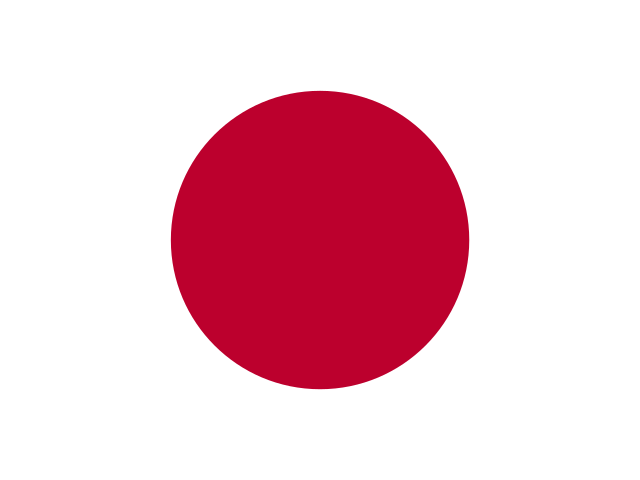
Photograph of Japan by Morio, licensed CC BY-SA 3.0, via Wikimedia Commons.