pathoffAll countries for university

University

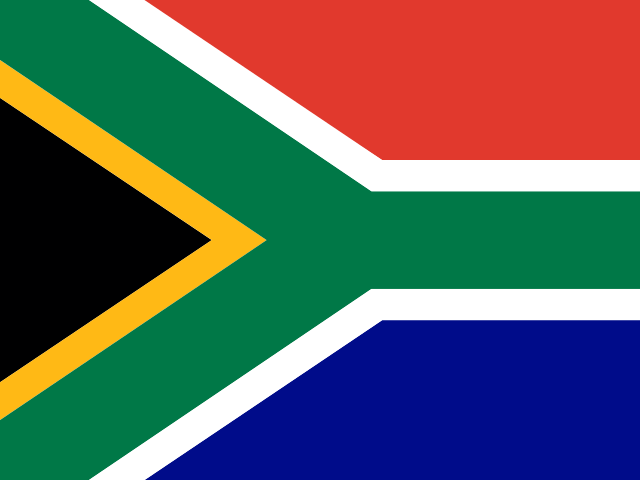
South Africa

The best universities in Africa, in English, for three thousand a year.

5/5
ingredients confirmed
Every ingredient this page asks for has a figure and a source.
Tuition
~$7.6–9.1k/yr
Living
~$750/mo
Single student, all in. Compared at country level, so capital cities and large metros run higher. The price level behind it prices the basket residents buy, and a foreign renter cannot reach the cheap end of local housing — poorer countries may still sit too low here.
Education
Recognised across the Commonwealth
Research impact 38th percentile globally — median of 20 ranked universities (CWTS Leiden Open Edition 2025). Research output, not teaching quality; it informs the band, it does not set the score.
Work after study
A skills list, and it does not need an employer first
Safety
Low
Low on the index, driven by violent crime rates that are among the highest recorded anywhere

More is being checked.

What we corrected here

Figures we published, and what reading the source did to them. The old ones were ours, not anyone else’s — this is our record of being wrong, kept where the figure it is about lives.

Tuition×2.7

We had about $3,100 a yearNow ~$7.6–9.1k/yr

It sat below even the local rate, before the surcharge international students actually pay.

Read from the source in 2026-09.

Where these figures came from

One row per ingredient. Open any of them for the source, how far we trust it, and when we last checked.

Tuition~$7.6–9.1k/yr

International undergraduates in South Africa pay the local tuition plus a surcharge, and the two universities do it differently, so both halves are read from each. The University of Cape Town’s 2026 fees booklet gives typical first-year tuition of R79,000 (BA and BSocSc), R80,410 (LLB), R86,300 (BSc engineering, at the midpoint of its range), R86,460 (BCom, midpoint) and R87,000 (BSc) — a median of R86,300 — and adds an International Term Fee of R80,400 a year for students from outside Africa, so R166,700. Wits publishes local first-year tuition of R61,480–77,250 (BA), R47,930–83,760 (LLB), R71,600 (BSc engineering), R52,050–80,750 (BSc) and R62,830–85,260 (BCom) — a median of R69,365 at midpoints — and states in its own general fees document that international undergraduates from outside SADC pay double the local tuition, so R138,730. The rule and the amount it multiplies come from the same publication, which is what makes doubling a quotation here rather than a calculation of ours. Medicine and health sciences are left out. Recorded at the median of the two, R152,715 a year. The previous figure, about $3,100, sat below even the local rate.

Confidence
printed in the source
Last checked
2026-09
Living~$750/mo

Pathoff judgement directed by evidence, not computed from it: the country’s position comes from the World Bank household consumption price level for 2024 (0.420 of the United States, CC BY 4.0 — the ICP benchmark carried forward annually by the World Bank’s own method); the US reference budget is ours. See the Pathoff method, section 12.

Single student, all in. Compared at country level, so capital cities and large metros run higher. The price level behind it prices the basket residents buy, and a foreign renter cannot reach the cheap end of local housing — poorer countries may still sit too low here.

Confidence
made by us from the source
EducationRecognised across the Commonwealth

Pathoff education rubric (the Pathoff method, section 9-1), degree band "Recognised within a bloc": Accepted across the Commonwealth and throughout Africa, with two or three universities known by name well beyond it and taught entirely in English. High in the band; short of the one above because outside the anglophone world the qualification is still assessed rather than assumed.

Research impact 38th percentile globally — median of 20 ranked universities (CWTS Leiden Open Edition 2025). Research output, not teaching quality; it informs the band, it does not set the score.

Confidence
made by us from the source
Work after studyA skills list, and it does not need an employer first

Pathoff outcome rubric (the Pathoff method, section 10-2), degree outcome band "A route that needs an employer": Graduation confers no period to stay, but the critical skills visa is granted against a published occupation list and can be held while looking for work, which is more than most employer-sponsored systems allow. At the top of the band because whether the route exists at all depends on being in a listed occupation.

Confidence
made by us from the source
Rule
No change known to us
Last checked
2026-09
SafetyLow

Global Peace Index 2026: rank 123 of 163, score 2.308. Converted by the Pathoff GPI formula (GPI in lib/scoring.ts)

Low on the index, driven by violent crime rates that are among the highest recorded anywhere

Confidence
made by us from the source

What it is like here

Cape Town and the Witwatersrand are the strongest research universities on the continent by a wide margin, they teach in English, and international undergraduate fees run about a tenth of what the same degree costs in Australia. Afterwards the critical skills visa is a genuine route for graduates in listed fields. The counterweight remains the safety score.

How the process works

1

Apply directly; teaching is in English

No language qualification, and admission is on academic record.

3–6 months
2

Study visa, with medical cover as a condition

Membership of a registered South African medical scheme is required for the visa.

2–5 months
3

Check the critical skills list before you choose a subject

It decides whether a route exists after graduation.

Timing not confirmed

Where students go

Cape Town
The strongest university, the best climate, the highest rents
Johannesburg / Pretoria
The largest employers and the widest choice
Stellenbosch
A small university town in the winelands

Open any ingredient above to see where its figure came from, how far we trust it and when we last checked. Nothing here is a substitute for the official source. Last reviewed 2026-09-04.

Photograph of South Africa by Der Berzerker from Washington, DC, USA, licensed CC BY-SA 2.0, via Wikimedia Commons.